
Software we build and run ourselves.
An independent lab. We write the tools we wanted to exist, host them on hardware we own, and hand out accounts one at a time — no growth team, no data to resell, and no service that disappears when somebody gets acquired.
01 Open services
Running in the open
Every one of these gets used by us daily before anyone else is let near it. Each has its own front door: open the one you want, ask for an account there, and a person approves it — not a form.
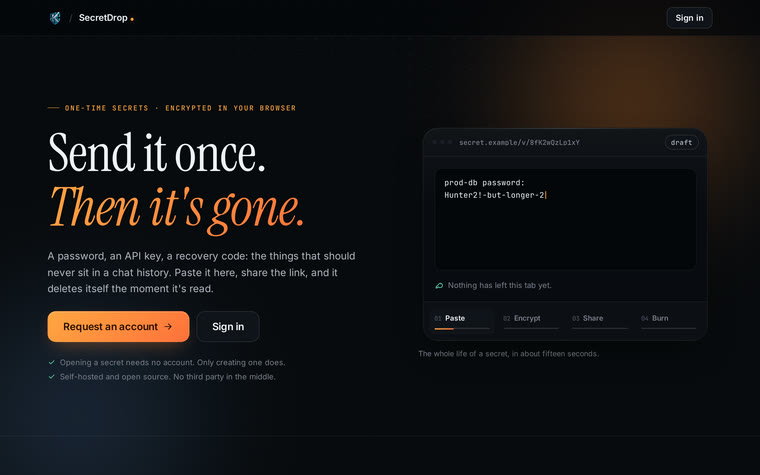
SecretDrop
liveA password that stops existing once it is read. Encrypted in your browser; whoever receives it needs no account.
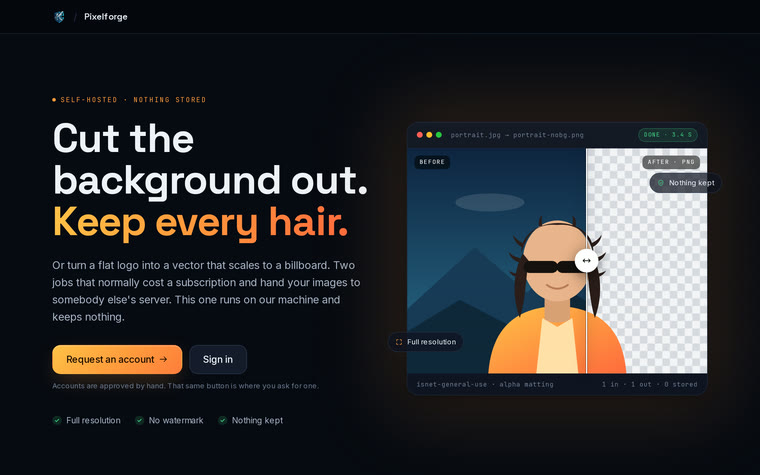
Pixelforge
liveCut a background out, or turn a logo into a vector. Full resolution, no watermark, nothing kept afterwards.

Not everything we build is a service we run. Arveil, an end-to-end encrypted messenger for families and small circles, is open source for you to host yourself. All projects.
02 Why trust this
Your data has somewhere to be, and it stays there
We run on our own infrastructure. Not a reseller of somebody else's platform, not a startup with an exit to plan — which is why the answers below can be this short.
Privacy
Nothing to sell
No advertising trackers, no pixels, no behavioural profiles. The only measurement is privacy-first aggregate analytics — and there is no business model that would reward us for looking at what you store.
Local first
Kept close, deleted for real
Where it can be, your content is encrypted before it ever leaves your device. What you set to expire is deleted rather than archived somewhere you cannot see.
By invitation
Small on purpose
Accounts are approved one at a time by a person. We are not trying to grow this into something that needs to monetise you to survive.
Open source
Inspect what runs
The source for all six is public, and each ships a container image built from a tagged commit — scanned before release, with provenance and an SBOM. Reading the code is one use of that. Running your own copy, with no licence and no seat count, is the other.
Three ways to use these →03 How to get these
Three ways to use them
The software is free and the source is public. What changes between these three is who runs it and who answers when something breaks.
Free · today
Run your own
Pull the image, point it at your identity provider, and it is yours. No licence, no seat count, nothing held back for a paid tier.
By invitation
Use ours
Ask for an account on the service you want; a person reads the request. Good for people, not for anything a company depends on.
Ask for a tool →Commercial
Have it deployed
On infrastructure you own: installed, integrated, backed up and kept up to date — by the people who wrote it.